
Your Brain Needs a Shutdown Sequence
What my grandfather taught me about leaving work at work.

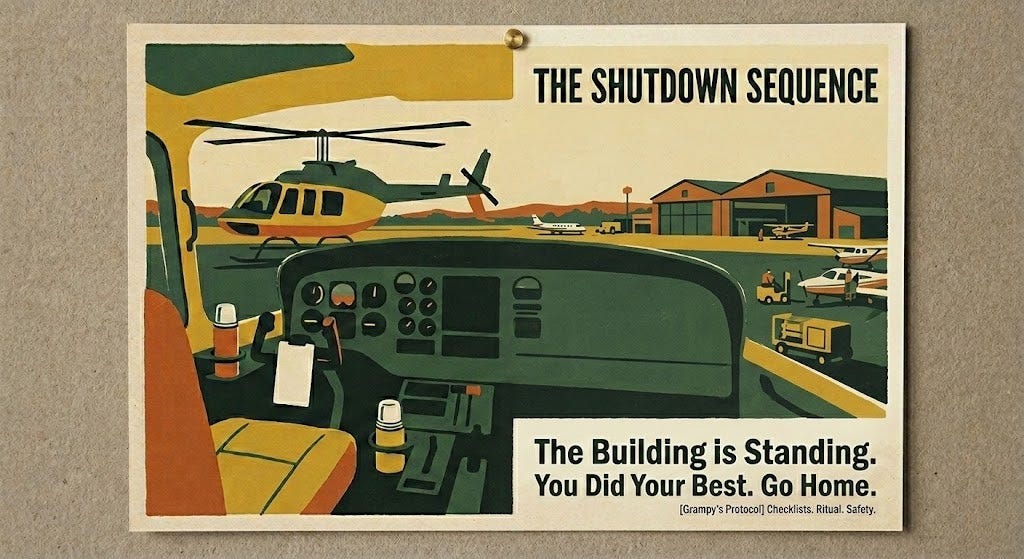
My grandfather was a helicopter pilot. Every flight began with a checklist and ended with one — no exceptions. The shutdown procedure was so effective that my mom still runs through a version of it when she turns off the car.
It’s a safety protocol. And it’s a model for anyone who has a difficult time shutting down at the end of the day.
I was talking with a coaching client recently, and she shared something that seemed elemental. She couldn’t turn her brain off at night. She’d get home after work and still be running through the day. Who said what. What she should have handled differently. What was waiting for her tomorrow.
She wasn’t sleeping well.
She wasn’t present.
She was still at work, even when she was at home.
I’ve experienced this myself and heard variations on the theme for years. Leading a school is a big job, and it’s never done. So it’s natural that some of that will follow you home.
The standard advice is to “be present” and “set boundaries”. It sounds like a poster on a wall, but it changes nothing.
Here’s a reframe: instead of willpower, you need a protocol.
When a pilot walks away after shutting down their helicopter, they are clear and confident that it’s “done”. Shutdown is a sequence — deliberate, ordered, and complete. When it’s done, it’s done.
The brain needs the same thing.
The Shutdown Sequence has five steps. It takes under five minutes.
Check your state: Before you can offload anything, you need to know what you’re carrying. Tired? Wound up? Still replaying a conversation? Write it down, describe it, in as few words as possible The brain releases what it names.
Brain dump: Everything unresolved or half-formed needs to get out of your head and onto paper or a screen. Don’t worry about filtering or organising. The goal is to unload. If it’s still in your head, it might follow you home.
Triage fast: Sort into 3 buckets. Tomorrow, later, and not mine. Sort, don’t solve. Then write tomorrow’s most important priority as a specific, intentional instruction.
Clear your triggers: Your eyes will snag on anything left out or open — a browser tab, a sticky note, a file left out. The cockpit has a defined off-state. So does your workspace. Close those tabs. Power off the computer. Tidy the desk to your standard, so there are no open loops.
Close the loop: Speak or write one closing sentence. “The building is standing. I did my best today.” The ritual is the point, and this is the moment when you signal to yourself that the shift is over.
The Shutdown Sequence is meant to work on you. Your caseload and your culture will still be there on Monday.
It will give your brain a signal that “we’re done for the day”. It’s time to park it and go home.
My grandfather’s shutdown protocol kept his aircraft safe. And it keeps my mom safe every time she parks the car.
You can build yours, too, and run it in a few minutes, day after day.
The building is standing. You did your best. Go home.
I’ve built a free Notion template for The Shutdown Sequence, with prompts, a self-check, and a printable laminated card for your desk or tack board. If you want to work through this, or anything else, I’d love to chat.